Published by The Daily Star on Sunday 16th November 2025
By Andrea Oldereide
EXCLUSIVE A former Scientologist has blasted Transport for London for allowing Scientology adverts on the Tube while junk food ads remain banned, calling it “disgraceful”
An ex-Scientologist has slammed Transport for London (TFL) for allowing the organisation’s adverts to appear on the capital’s public transport, branding it “disgraceful”. According to him, TFL is promoting a group with a long history of dangerous rhetoric.
Last week, Alexander Barnes-Ross, a former member of the Church of Scientology who now spends his time advocating against the organisation, took to his Threads page to denounce an advertisement he had spotted in the TFL network. At the time, he wrote: “Scientology ads have reappeared at Tottenham Court Road.
“As an ex-Scientologist, these are deeply offensive, concerning and re-traumatising. When will @transportforlondon realise their ad policy needs updating?
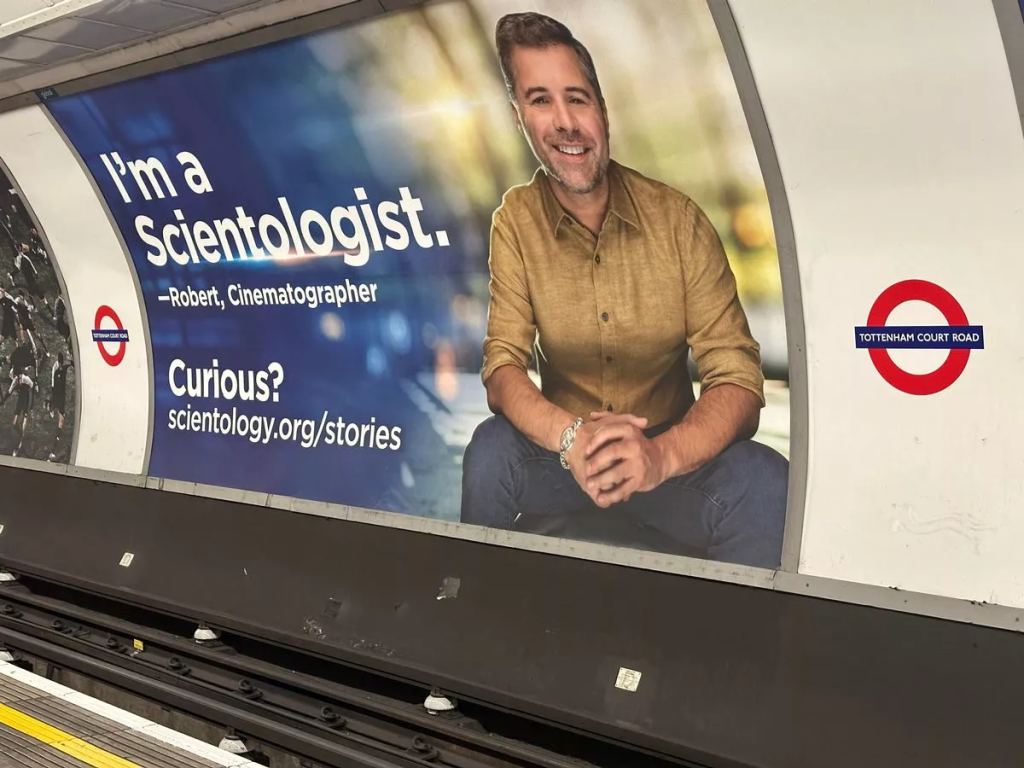
“Junk food ads are banned, but not abusive cults?!! @hinabokharild @sadiq @mayorofldn”
In 2019, TFL introduced a ban on advertising junk food, specifically products high in fat, salt, and sugar, across its network, which includes the Underground, buses, and stations. The policy was implemented to combat child obesity and has been shown in studies to reduce the purchase of unhealthy foods.
Nevertheless, Barnes-Ross viewed TFL’s advertisement regulations as a hypocritical rule. Speaking exclusively to the Daily Star, the 30-year-old said: “I think it’s absolutely disgraceful that Transport for London thinks it’s acceptable to promote this organisation.
“Because, for example, in Dianetics, Scientology’s bible, the number one book in Scientology, it teaches that if you are LGBTQIA+ or any sort of part of that community, you are a sexual pervert and you should be disposed of quietly without sorrow.
“So by advertising this group, TFL are forwarding an anti-LGBTQ+ [message], which I think is disgraceful.”
Barnes-Ross’ claim that Scientology’s foundational text, “Dianetics: The Modern Science of Mental Health” by L. Ron Hubbard, explicitly teaches that LGBTQIA+ individuals are “sexual perverts” who “should be disposed of quietly without sorrow” is a paraphrase and not a direct quote from the book. However, it is true that both “Dianetics” and subsequent Scientology writings contain language that pathologises same-sex attraction.
In “Dianetics”, which was published in 1950, Hubbard describes homosexuality as a “sexual perversion” and classifies it as an illness or aberration, reflecting the prejudices of that era . In Hubbard’s later work, “Science of Survival”, he discusses people at the lowest levels of his “tone scale”, including “sexual perverts”, and suggests that society would be better off if such individuals were “disposed of quietly and without sorrow”. However, the Church of Scientology today claims to be non-discriminatory.
“I think it’s outrageous to think that junk food ads are banned on the London Underground Network because junk food is seen as harmful but not abusive cults,” Barnes-Ross said. He pointed to several official findings to back up his concerns about Scientology’s presence in public advertising.
In 1971, a UK government inquiry led by Sir John Foster concluded that Scientology’s practices could be “socially harmful” and potentially damaging to mental health, particularly for vulnerable individuals. In 1984, Mr Justice Latey of the High Court described Scientology as “corrupt, sinister and dangerous” in a child custody case, warning that it was “a cult” that sought to control its members, including children.
Additionally, in 1999, the UK Charity Commission refused to grant Scientology charitable status, ruling that it did not provide a public benefit as required by law. “And yet TFL haven’t found a reason to reject these ads,” Barnes-Ross said.
A TFL spokesperson has since told the Daily Star: “The advertisement was reviewed against our advertising policy and was found to be compliant.” The spokesperson further pointed to its advertising policy .
As per its advertising policy, TFL does not specifically ban religious or belief-based advertisements as long as they do not break the law, cause serious offence, or go against equality and social standards. In contrast, the policy has a clear and specific rule that bans advertisements for food and drinks high in fat, salt, or sugar to help promote public health.
So, while Scientology ads are allowed if they follow the general rules, junk food ads are not allowed because of a direct policy restriction.